


Why
Agents are great at probabilistic tasks. They’re terrible at three things:- Judgment — when the right answer isn’t in any prompt, only a domain expert knows.
- System uncertainty — when an upstream API just stopped responding and nobody knows whether the payment actually went through.
- Embodiment — when the task needs hands in the physical world.
awaithumans is the primitive.
What you get
- One function in Python and TypeScript:
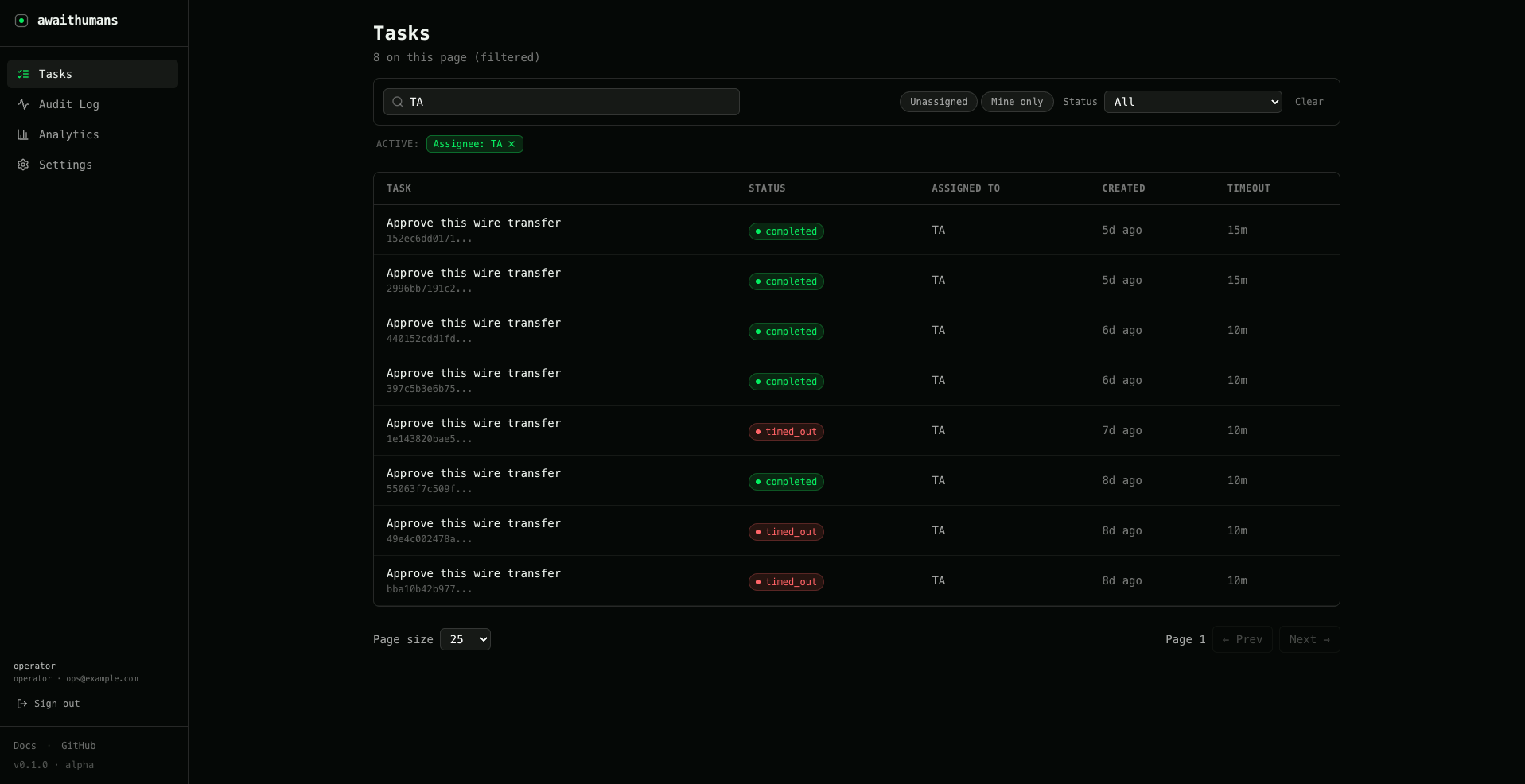
await_human()/awaitHuman(). - Channels: deliver tasks to humans via Slack, email, or a built-in web dashboard.
- Adapters for durable execution: Temporal, LangGraph. Workflows park while waiting; survive restarts.
- Verification: optional AI quality-check + NL parsing layer (Claude / OpenAI / Gemini / Azure).
- Routing: assign tasks to specific people, pools, or roles.
- Self-host in one command:
awaithumans devfor development,docker compose upfor production. - Apache 2.0 across the SDK, server, dashboard, adapters, and channels. Free forever for self-hosted use, with an explicit patent grant.
Five-minute test
Where to next
Quickstart
Get a task delivered to your dashboard in five minutes.
Concepts
Mental model: task lifecycle, the four buckets, idempotency.
Temporal adapter
Durable workflows that pause for hours or days while waiting.
LangGraph adapter
Interrupt-based human-in-the-loop in a LangGraph node.