> ## Documentation Index
> Fetch the complete documentation index at: https://docs.awaithumans.dev/llms.txt
> Use this file to discover all available pages before exploring further.
# Introduction
> The human layer for AI agents. Your agents already await promises. Now they can await humans.
```python theme={"system"}
from pydantic import BaseModel
from awaithumans import await_human_sync
class RefundPayload(BaseModel):
amount: int
customer_id: str
class RefundDecision(BaseModel):
approved: bool
reason: str = ""
result = await_human_sync(
task="Approve this $250 refund?",
payload_schema=RefundPayload,
payload=RefundPayload(amount=250, customer_id="cus_demo"),
response_schema=RefundDecision,
timeout_seconds=900,
)
if result.approved:
print(f"refund approved: {result.reason}")
```
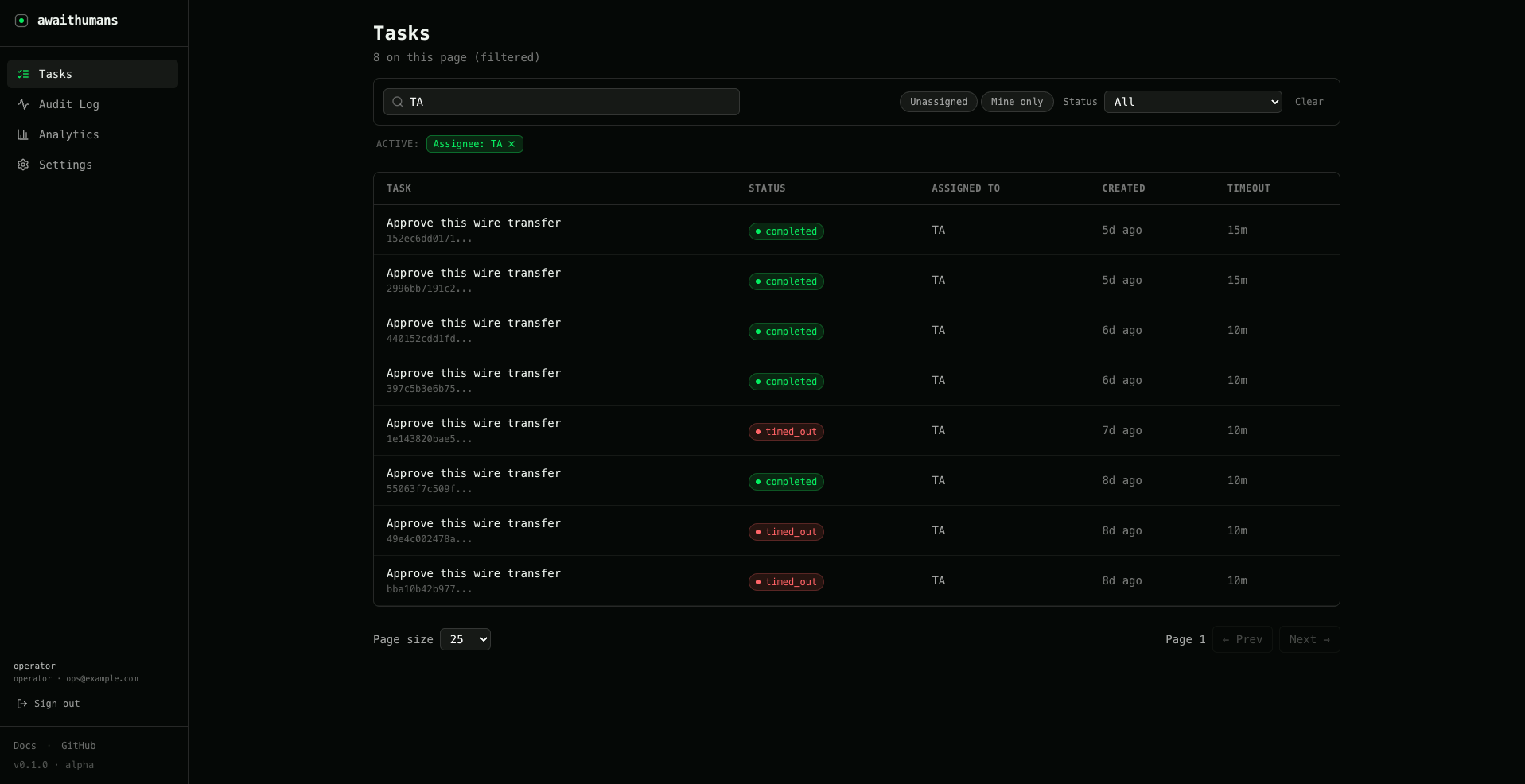
That's the whole product. One function call in your agent code; a real human in the loop on the other side, reviewing through Slack, email, or a web dashboard. Your agent waits — durably, idempotently — until they decide.

 ## Why
Agents are great at probabilistic tasks. They're terrible at three things:
1. **Judgment** — when the right answer isn't in any prompt, only a domain expert knows.
2. **System uncertainty** — when an upstream API just stopped responding and nobody knows whether the payment actually went through.
3. **Embodiment** — when the task needs hands in the physical world.
These don't go away with bigger models. Every production agent system needs a human-in-the-loop layer eventually. `awaithumans` is the primitive.
## What you get
* **One function** in [Python](/sdk/python) and [TypeScript](/sdk/typescript): `await_human()` / `awaitHuman()`.
* **Channels**: deliver tasks to humans via [Slack](/channels/slack), [email](/channels/email), or a built-in web [dashboard](/channels/overview#dashboard).
* **Adapters** for durable execution: [Temporal](/adapters/temporal), [LangGraph](/adapters/langgraph). Workflows park while waiting; survive restarts.
* **Verification**: optional AI [quality-check + NL parsing](/adapters/verifier) layer (Claude / OpenAI / Gemini / Azure).
* **Routing**: assign tasks to specific people, [pools](/routing/overview), or roles.
* **Self-host in one command**: `awaithumans dev` for development, `docker compose up` for production.
* **Apache 2.0** across the SDK, server, dashboard, adapters, and channels. Free forever for self-hosted use, with an explicit patent grant.
## Five-minute test
```bash theme={"system"}
pip install "awaithumans[server]"
awaithumans dev
```
Open the URL it prints, create your operator account, then [run the quickstart](/quickstart). First task in five minutes.
## Where to next
Get a task delivered to your dashboard in five minutes.
Mental model: task lifecycle, the four buckets, idempotency.
Durable workflows that pause for hours or days while waiting.
Interrupt-based human-in-the-loop in a LangGraph node.
## Why
Agents are great at probabilistic tasks. They're terrible at three things:
1. **Judgment** — when the right answer isn't in any prompt, only a domain expert knows.
2. **System uncertainty** — when an upstream API just stopped responding and nobody knows whether the payment actually went through.
3. **Embodiment** — when the task needs hands in the physical world.
These don't go away with bigger models. Every production agent system needs a human-in-the-loop layer eventually. `awaithumans` is the primitive.
## What you get
* **One function** in [Python](/sdk/python) and [TypeScript](/sdk/typescript): `await_human()` / `awaitHuman()`.
* **Channels**: deliver tasks to humans via [Slack](/channels/slack), [email](/channels/email), or a built-in web [dashboard](/channels/overview#dashboard).
* **Adapters** for durable execution: [Temporal](/adapters/temporal), [LangGraph](/adapters/langgraph). Workflows park while waiting; survive restarts.
* **Verification**: optional AI [quality-check + NL parsing](/adapters/verifier) layer (Claude / OpenAI / Gemini / Azure).
* **Routing**: assign tasks to specific people, [pools](/routing/overview), or roles.
* **Self-host in one command**: `awaithumans dev` for development, `docker compose up` for production.
* **Apache 2.0** across the SDK, server, dashboard, adapters, and channels. Free forever for self-hosted use, with an explicit patent grant.
## Five-minute test
```bash theme={"system"}
pip install "awaithumans[server]"
awaithumans dev
```
Open the URL it prints, create your operator account, then [run the quickstart](/quickstart). First task in five minutes.
## Where to next
Get a task delivered to your dashboard in five minutes.
Mental model: task lifecycle, the four buckets, idempotency.
Durable workflows that pause for hours or days while waiting.
Interrupt-based human-in-the-loop in a LangGraph node.